
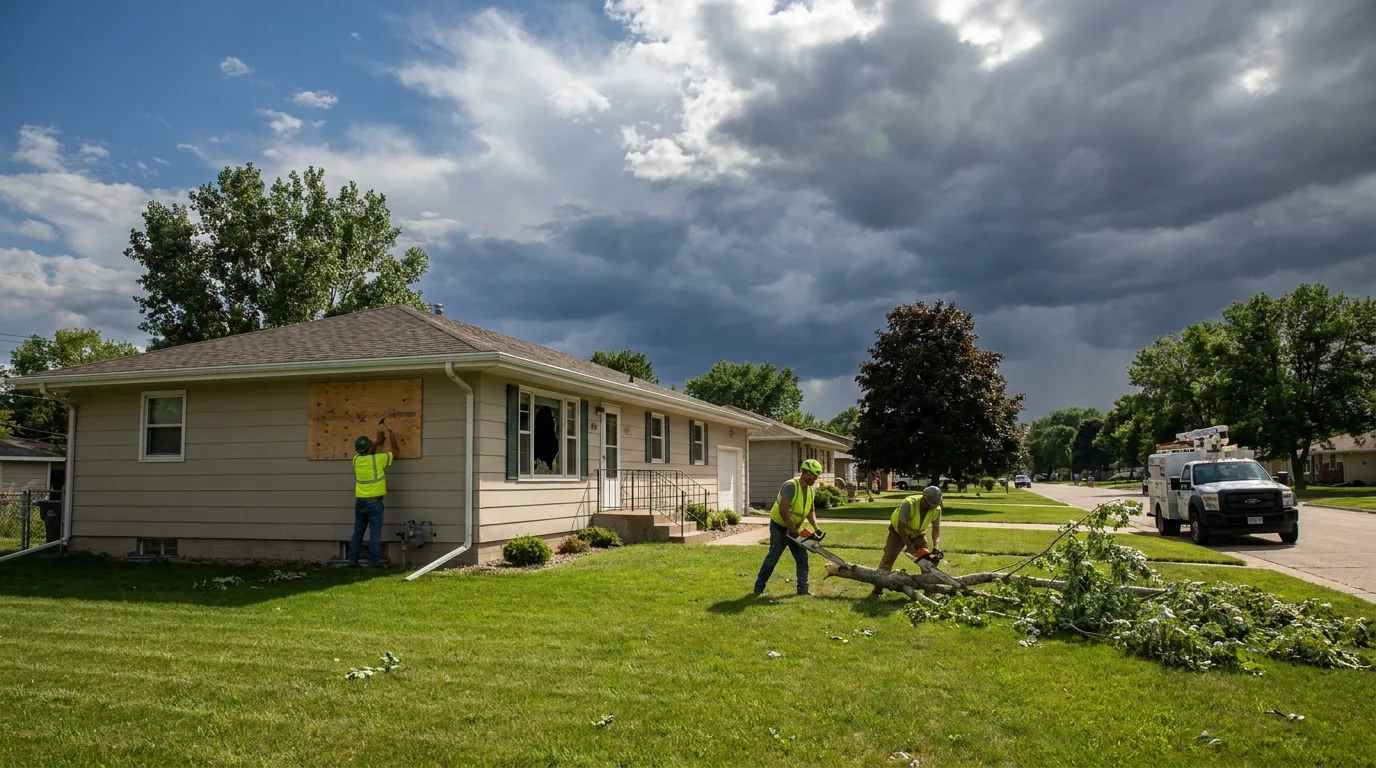
Storm Damage Restoration in Sioux Falls
Storm damage restoration in Sioux Falls, SD. Insurance billing accepted. Call (605) 965-2727.
Our IICRC-certified technicians are headquartered right here in Sioux Falls and are typically on-site within 60 minutes of your call.
When a severe thunderstorm rolls across the South Dakota plains and stalls over Sioux Falls, it doesn’t just bring rain — it brings baseball-sized hail, straight-line winds that routinely exceed 70 mph, and the occasional tornado touchdown that can strip a roof down to the decking in seconds. Homes in established neighborhoods like McKennan Park and Cathedral Historic District, where mature cottonwoods and American elms line every block, face a compounding hazard: those beautiful old trees become projectiles. If your property took a hit, the clock is already running on secondary damage.
Why Sioux Falls Properties Take Storm Damage Hard
Sioux Falls sits in a corridor where cold Canadian air masses collide with warm, moisture-laden air pushing north from the Gulf — a recipe for violent, fast-moving storms from late April through September. The city averages roughly 45 days of severe thunderstorm activity per year, and hail is the most common culprit behind insurance claims in Minnehaha County.
The housing stock adds another layer of complexity. Older homes in the All Saints and Whittier neighborhoods were built with dimensional lumber framing, wood shake or asphalt shingles layered over original cedar, and in many cases, original single-pane windows. Those materials absorb impact differently than modern construction — a hailstone that dents a newer architectural shingle can crack a 1960s tab shingle outright, opening the roof deck to water infiltration within hours. Meanwhile, the expansive clay soils common across much of the metro mean that water pooling around a foundation after a storm doesn’t drain quickly; it sits, and it finds its way inside.
What Storm Damage Restoration Looks Like Here
Every storm job starts with a systematic exterior-to-interior assessment before any debris is moved. That sequence matters because disturbing a tree that’s partially resting on a damaged roof can shift load and worsen structural compromise. Our process:
1. Stabilization and emergency tarping. Exposed roof decking gets covered fast to stop active water intrusion. We document every damaged surface with photos and measurements before tarping — that documentation is your insurance file.
2. Structural and envelope inspection. We check fascia, soffits, gutters, siding, and window frames for impact damage, then move inside to assess ceilings, walls, and subfloors for moisture infiltration. In homes near Prairie Green and other areas with finished basements, we pay particular attention to window wells and egress openings, which collect debris and water during heavy rain events.
3. Water extraction and drying. If rain entered through a compromised roof or broken windows, standing water comes out first with truck-mounted extraction, followed by industrial air movers and desiccant dehumidifiers calibrated for Sioux Falls’s humidity levels. South Dakota’s continental climate means indoor humidity can swing dramatically — equipment settings that work in July require adjustment in September.
4. Debris removal and structural repair. Tree limbs, damaged roofing materials, and destroyed siding come off the property. Structural repairs — decking, framing, roofing, siding, windows — follow once the envelope is dry and stable.
Navigating Insurance Claims After a Sioux Falls Storm
South Dakota’s major storm seasons tend to generate claim surges that slow adjuster response times across the metro. Filing quickly and with thorough documentation gives your claim a cleaner path through the queue. We provide a complete written scope of damage, itemized materials list, and photo set in the format most carriers operating in the Sioux Falls market expect — including Farmers, State Farm, and Acuity, which are among the most common homeowner carriers in the 57105 and 57103 ZIP codes.
If your adjuster’s estimate comes in lower than the actual scope of work — which happens frequently after large regional storm events when adjusters are working quickly across hundreds of properties — we can provide a supplemental estimate and meet with your adjuster on-site.
Local Note
One pattern we see repeatedly in the Cathedral Historic District and surrounding older neighborhoods: homes built before 1960 often have original plank roof sheathing rather than plywood or OSB. When hail or wind damage allows water past the shingles, that plank sheathing absorbs moisture unevenly — boards swell at different rates, which can push roofing nails and create secondary leak points that don’t show up until the next rain. If your home is pre-1960 and you’ve had any roof penetration, ask specifically about a sheathing inspection before the roofing crew closes everything up. It’s a step that gets skipped when contractors are moving fast after a big storm event, and it’s one of the more common sources of callbacks we see from work done by others.
If your Sioux Falls property is dealing with storm damage right now — whether it’s a tree through the roof, hail-punched siding, or water working its way through a compromised envelope — call Crew Restoration & Construction at (605) 965-2727. We’re based here in Sioux Falls, we know the neighborhoods, and we’ll give you a straight assessment of what needs to happen and in what order.
Headquartered right here in Sioux Falls — ★ 4.8 · 488 Google reviews
“Great bunch!! Well organized and everything was as it should be. Thanks.” — Jason, July 2026Read our reviews on Google →
Storm Damage Restoration in Sioux Falls: Service Coverage
Frequently Asked Questions
How fast can you arrive for storm damage restoration in Sioux Falls?
How quickly can Crew Restoration & Construction reach homes in the McKennan Park or Cathedral Historic District after a storm?
Does Sioux Falls's clay soil affect storm damage repair, particularly around foundations?
Are older homes in the Whittier and All Saints neighborhoods more vulnerable to storm damage than newer construction?
What happens if the insurance adjuster's estimate doesn't cover the full scope of storm repairs on my Sioux Falls home?
How long does a typical storm damage restoration take for a single-family home in Sioux Falls?
Storm Damage Restoration response in Sioux Falls
Most Sioux Falls calls see a technician on-site within 60 minutes from our Sioux Falls headquarters.