Mold Remediation in Sioux Falls
Mold remediation in Sioux Falls and surrounding areas. Insurance billing accepted. Call (605) 965-2727.
You noticed the smell first, that damp, earthy odor behind the drywall or under the bathroom vanity. Then came the discoloration: a gray-green bloom spreading along the baseboard, or dark streaking across ceiling tiles you’d been meaning to look at for weeks. Mold doesn’t announce itself loudly, but once a colony establishes, it can double in coverage every 24 to 48 hours under the right humidity conditions. What starts as a small patch after a slow pipe leak or a flooded basement can become a structural and air-quality problem that affects every room connected to your HVAC system.
What mold remediation actually involves
Mold removal isn’t scrubbing visible growth with bleach and calling it done. Surface cleaning leaves the mycelium, the root structure, intact inside porous materials like drywall, insulation, and wood framing. Effective mold abatement means physically removing contaminated material, controlling airborne spore counts during the work, and verifying through post-remediation testing that the environment has returned to normal fungal ecology.
The work typically involves:
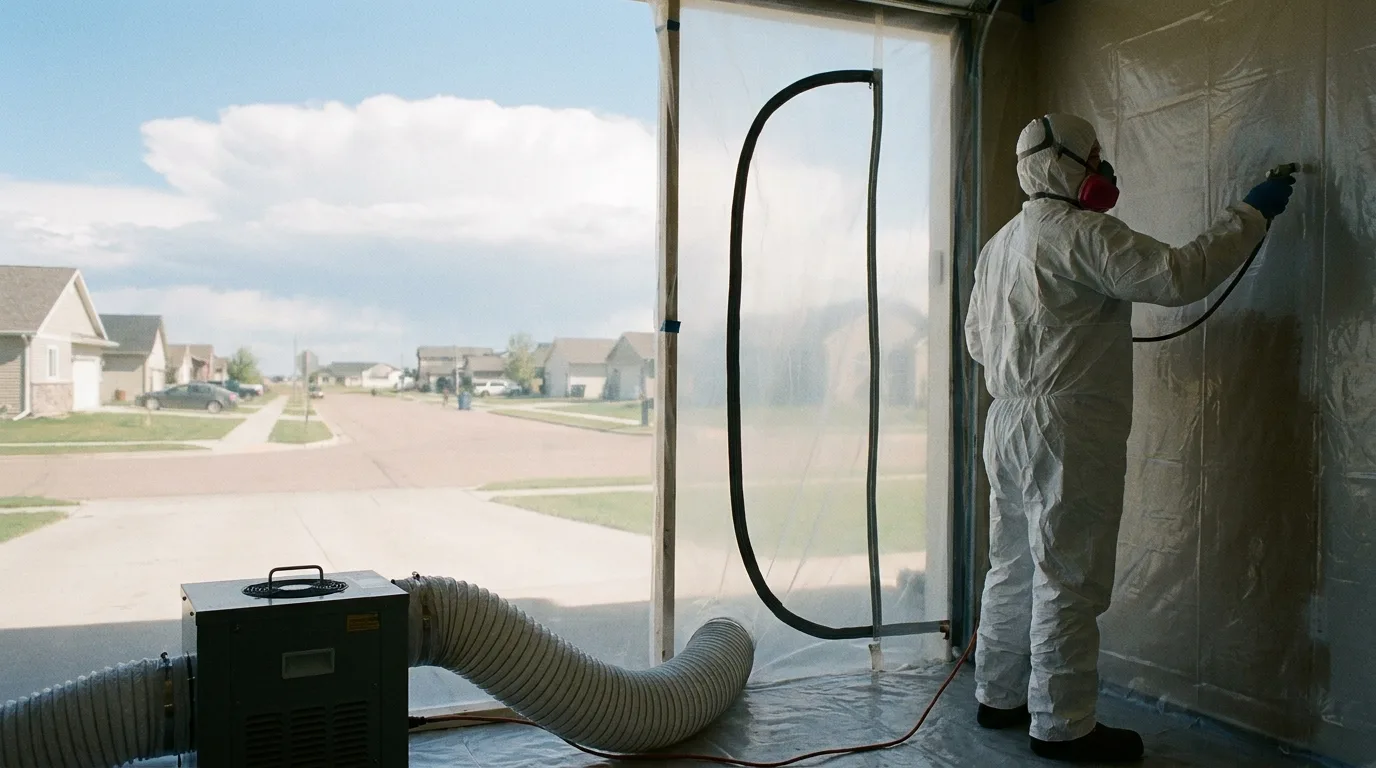
- Containment barriers, 6-mil poly sheeting sealed with tape to isolate the work zone and prevent cross-contamination to clean areas
- Negative air pressure, HEPA-filtered air scrubbers that exhaust contaminated air outside the structure, keeping spore counts in adjacent rooms from spiking
- Controlled demolition, removing drywall, insulation, or subfloor material that has been colonized beyond surface cleaning thresholds
- HEPA vacuuming and antimicrobial treatment, cleaning structural cavities and framing before encapsulation or reconstruction begins
- Clearance air sampling, post-remediation testing to confirm spore counts have returned to acceptable baseline levels before containment comes down
Timeline varies with the size of the affected area and how deeply moisture has penetrated building materials. A single bathroom with contained growth may be resolved in one to two days. Whole-basement or multi-room mold cleanup, common after prolonged water intrusion in Sioux Falls homes with finished lower levels, can run four to seven days including drying time.
Our process
1. Moisture source identification and assessment Mold is a symptom. Before any mold cleanup begins, the moisture source driving growth has to be identified and stopped, whether that’s a slow roof leak, a condensation problem on cold-water pipes, or residual saturation from a previous water loss. We map affected areas using thermal imaging and moisture meters to understand the full scope before writing a scope of work.
2. Containment setup We establish a full containment zone around affected areas using poly barriers and zipper-door entry points. HEPA air scrubbers are positioned to create negative pressure inside the containment, so disturbed spores exhaust out rather than migrate to clean living spaces. Workers enter and exit through a decontamination chamber.
3. Controlled demolition and mold abatement Contaminated drywall, insulation, and other porous materials are removed in sealed bags and disposed of per South Dakota solid waste guidelines. Structural framing and concrete surfaces are HEPA-vacuumed, then treated with an EPA-registered antimicrobial agent. We do not encapsulate over active mold, material that cannot be cleaned to a visually clean standard is removed.
4. Structural drying (if needed) If underlying framing or concrete still carries elevated moisture readings after demolition, we place desiccant or refrigerant dehumidifiers and air movers inside the contained area and monitor daily until materials reach dry standard. Rebuilding over wet framing is one of the most common mistakes that leads to mold recurrence.
5. Post-remediation clearance testing Before containment comes down, air samples are collected inside the work zone and compared against an outdoor control sample. Spore counts and species composition need to reflect normal outdoor fungal ecology, not elevated Stachybotrys, Chaetomium, or Aspergillus/Penicillium counts that indicate active growth. Clearance testing is the only objective way to confirm the remediation worked.
What separates a good mold remediation response from a bad one
The most common failure point is inadequate containment. Disturbing mold growth without negative air pressure and proper barriers can spread spores through an HVAC system and seed new colonies in rooms that were previously unaffected. A job that looks finished on day one can produce a worse problem by day thirty.
The second failure is treating the surface without addressing moisture. Antimicrobial sprays applied to visibly moldy drywall while the wall cavity is still wet will not prevent regrowth. Insurance adjusters and industrial hygienists reviewing a claim look for moisture documentation, pre- and post-remediation moisture readings, to confirm the underlying cause was resolved, not just painted over.
Skipping clearance testing is the third common shortcut. Without post-remediation air sampling, there’s no objective confirmation the work was effective. Some contractors skip it to cut cost; others skip it because they’re not set up to coordinate with a third-party industrial hygienist. Clearance documentation also matters significantly for resale, buyers and their inspectors will ask for it.
Black mold remediation (Stachybotrys chartarum) gets particular attention because it requires water-saturated material to grow and is often a sign of a long-standing, hidden leak. Its remediation follows the same physical process as other mold species, containment, removal, drying, clearance, but the presence of Stachybotrys often signals more extensive hidden damage than the visible surface suggests.
What does mold remediation cost?
Typical costs run across a wide range depending on the size of the affected area, the material types involved, and whether reconstruction is needed after demolition. Most homeowners pay somewhere between $1,500 and $6,000 for a contained single-area remediation; larger losses involving multiple rooms, finished basements, or HVAC contamination can run significantly higher. The table below reflects typical industry ranges, not quotes from Crew Restoration & Construction.
| Scenario | Typical industry range |
|---|---|
| Single bathroom, surface mold on tile/grout | $500 – $1,500 |
| Single room, drywall removal required | $1,500 – $4,000 |
| Crawl space mold abatement | $2,000 – $6,000 |
| Finished basement, multiple affected areas | $4,000 – $12,000 |
| HVAC system mold contamination | $3,000 – $10,000 |
| Whole-house remediation after prolonged water intrusion | $10,000 – $30,000+ |
Every loss is different, and Crew Restoration & Construction provides a written scope of work before any remediation begins so you know exactly what’s included. Homeowners insurance typically covers mold remediation when it results directly from a covered water loss, a burst pipe, appliance failure, or storm-driven water intrusion, but policies vary significantly on standalone mold coverage, and documentation of the originating cause is critical to a successful claim.
Seasonal and regional considerations
Sioux Falls sits in a climate that creates two distinct mold-risk windows. Summer brings high dewpoints, July humidity regularly pushes into the 70–80% relative humidity range, which means finished basements and crawl spaces without adequate dehumidification are under constant pressure. Condensation on cold concrete walls and cold-water pipes is common and often goes unnoticed until mold has been growing for weeks.
The second window is late winter and early spring, when freeze-thaw cycles stress roofing, flashing, and foundation seals. Ice damming on older Sioux Falls homes, particularly the craftsman and mid-century ranch stock common in McKennan Park and the Cathedral District, can push meltwater into wall cavities and attic spaces where it sits undetected. By the time interior staining appears, mold has often been colonizing for 30 to 60 days.
Service area
Crew Restoration & Construction handles mold remediation throughout Sioux Falls and the surrounding region, including Brandon, Tea, Harrisburg, Dell Rapids, and Baltic. If you’re outside these areas, call us, we’ll let you know if we can help or point you in the right direction.
If you’ve spotted visible growth, noticed a persistent musty odor, or recently had a water loss that wasn’t fully dried, don’t wait to see if it resolves on its own, it won’t. Call Crew Restoration & Construction at (605) 965-2727 to schedule an air quality assessment and find out exactly what you’re dealing with before it spreads further.
Frequently Asked Questions
Does homeowners insurance cover mold remediation?
What's the difference between mold remediation and mold removal — is there actually a distinction?
When does mold remediation require full containment versus a simpler cleanup approach?
How do I know the mold remediation actually worked — what does clearance testing involve?
Can mold come back after professional remediation, and what prevents recurrence?
Looking for the best mold remediation company in Sioux Falls?
Crew Restoration & Construction provides licensed and insured mold remediation in Sioux Falls, SD and the surrounding area. Customers rate us 4.9 out of 5 stars across 564 Google reviews. We answer calls 24/7 — call (605) 965-2727 for immediate help.
Request a Free Mold Remediation Estimate
Tell us what happened and we'll get back to you fast — usually within one business hour.
Need Mold Remediation now?
We respond 24/7 across Sioux Falls and surrounding SD cities.
Related Coverage
- Our Restoration Services
- Contact Crew Restoration & Construction
- Mold Remediation in Brandon
- Mold Remediation in Brookings
- Mold Remediation in Canton
- Mold Remediation in Dell Rapids
- Mold Remediation in Flandreau
- Mold Remediation in Harrisburg
- Mold Remediation in Hartford
- Mold Remediation in Le Mars
- Mold Remediation in Lennox
- Mold Remediation in Luverne
- Mold Remediation in Madison
- Mold Remediation in North Sioux City
- How To Choose a Restoration Company in (Without Getting Burned)
- How To Test for Mold in Your Home (DIY Kits vs a Pro Inspection)
- 7 Signs You Have Hidden Mold (and What To Do Next)