
Mold Remediation in Sioux Falls
Mold remediation in Sioux Falls, SD. Insurance billing accepted. Call (605) 965-2727.
Our IICRC-certified technicians are headquartered right here in Sioux Falls and are typically on-site within 60 minutes of your call.
Sioux Falls sits in a climate band that swings from brutal February cold snaps to humid, storm-heavy summers — and that range creates the exact moisture conditions mold needs to take hold. When snowmelt seeps into a basement in McKennan Park or a summer thunderstorm drives water through an aging foundation in the Cathedral Historic District, spores can begin colonizing porous materials in as little as 24 to 48 hours. Crew Restoration & Construction is based here in Sioux Falls, which means when you call (605) 965-2727, you’re reaching a local crew that knows this city’s housing stock, its weather patterns, and its neighborhoods — not a national dispatch center routing a truck from three counties away.
Why Sioux Falls Properties See Mold Issues
The Big Sioux River corridor and the low-lying areas near Falls Park aren’t the only places where moisture accumulates — it happens quietly in crawl spaces, behind finished basement walls, and inside HVAC chases across the metro. Sioux Falls receives an average of nearly 25 inches of precipitation annually, much of it concentrated in late spring and early summer. That rain arrives fast, and older storm drainage infrastructure in neighborhoods like Whittier and All Saints can struggle to redirect it quickly enough to prevent water from pressing against foundation walls.
The city’s housing stock adds another layer of complexity. Homes built before 1970 — common throughout the Cathedral Historic District and the blocks surrounding Sanford USD Medical Center — frequently have original fiberglass or cellulose insulation packed into wall cavities. That material holds moisture for weeks without any visible sign on the surface. By the time a homeowner notices a musty odor or a dark stain on drywall, mold colonies may already be well established behind the finish layer.
South Dakota’s freeze-thaw cycle also drives mold risk in ways that aren’t immediately obvious. Water that infiltrates masonry during a January thaw can refreeze, expand, and widen micro-cracks — then melt again in March and wick inward. Repeated over several winters, this process can saturate the interior face of a block foundation wall without a single visible leak event.
Our Mold Remediation Process in Sioux Falls
Every job starts with a thorough assessment — not a visual walk-through, but a moisture-mapping inspection using thermal imaging and calibrated moisture meters to locate hidden saturation behind walls and under flooring. We identify the moisture source first, because mold remediation without addressing the source is a temporary fix.
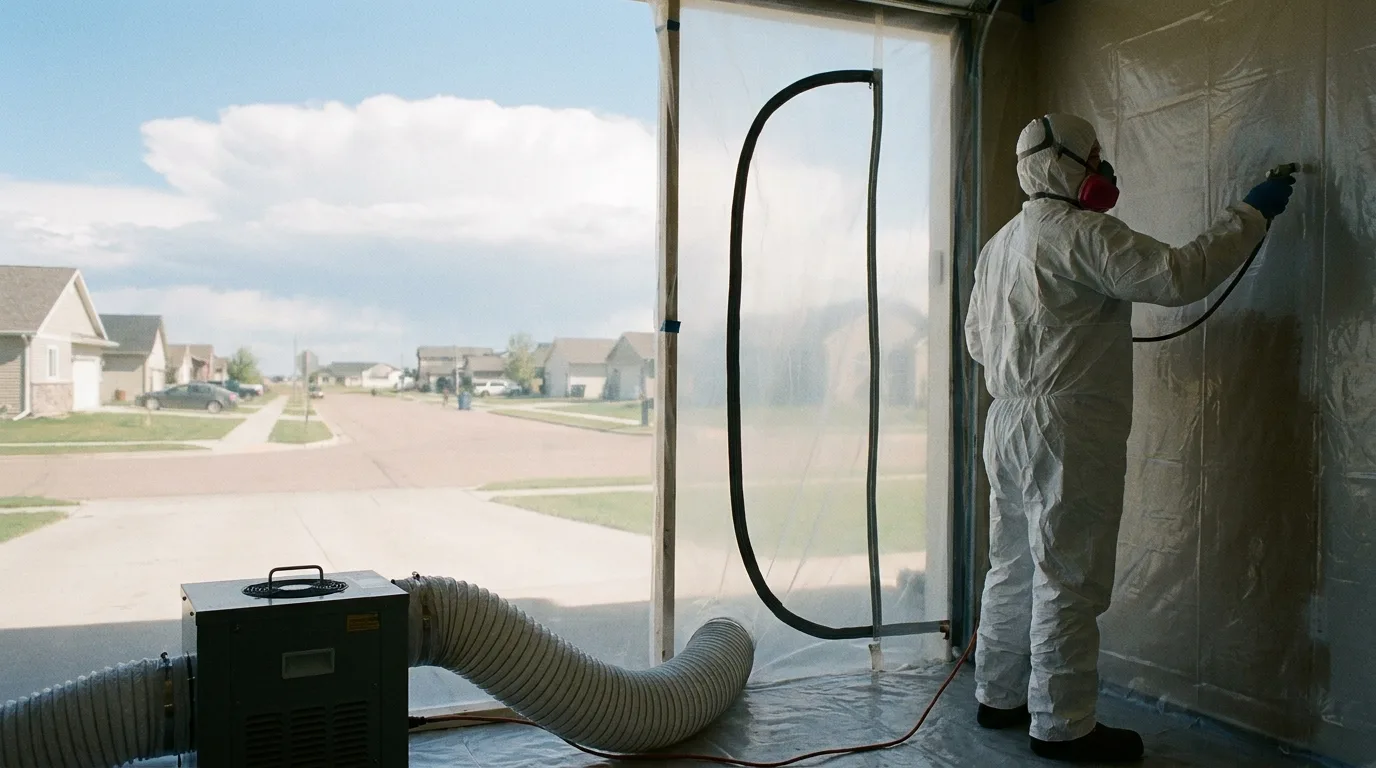
Once the scope is defined, we establish containment using negative-air pressure chambers and 6-mil poly barriers to prevent cross-contamination to unaffected areas of the home. HEPA-filtered air scrubbers run continuously throughout the work. Affected porous materials — drywall, insulation, wood framing where necessary — are carefully removed and bagged for disposal in accordance with South Dakota Department of Environment and Natural Resources guidelines.
Surfaces are then treated with EPA-registered antimicrobial agents, and structural components are dried to manufacturer-specified moisture content before any reconstruction begins. We don’t hand off the rebuild to a separate contractor — our construction division handles framing, insulation, and drywall in-house, which means one point of contact from the first call through the final coat of paint.
Sioux Falls Insurance Coordination
Mold claims in South Dakota can be complicated by policy language around “sudden and accidental” water events versus slow leaks. A burst pipe in a Prairie Green home is typically covered; a slow drip behind a vanity that went unnoticed for six months often is not. We document every loss thoroughly — moisture readings, photographs of affected materials, written scope of damage — to give your adjuster a clear picture of what happened and what it will take to fix it.
We work directly with most major carriers and can communicate with your adjuster throughout the process. Homeowners in the 57103 and 57105 ZIP codes have found this particularly helpful when claims involve both the mold remediation scope and the subsequent reconstruction work, which adjusters sometimes split into separate line items.
Local Note
Homes in the Cathedral Historic District and parts of All Saints were frequently built with plaster-and-lath wall systems rather than modern drywall. Plaster is denser and slower to release absorbed moisture than gypite board — which means that even after the visible mold is removed and the surface looks clean, the substrate behind it can remain damp enough to support regrowth for weeks. On these jobs, we extend the drying phase and take additional moisture readings at the lath layer before closing the wall. It adds time, but it’s the difference between a remediation that holds and one that fails a post-clearance air test.
If you’re seeing signs of mold in your Sioux Falls home — discoloration on walls, a persistent musty smell, or unexplained allergy symptoms that worsen indoors — call Crew Restoration & Construction at (605) 965-2727. We’ll assess the situation, explain your options clearly, and get the work done right the first time.
Headquartered right here in Sioux Falls — ★ 4.8 · 488 Google reviews
“Great bunch!! Well organized and everything was as it should be. Thanks.” — Jason, July 2026Read our reviews on Google →
Mold Remediation in Sioux Falls: Service Coverage
Frequently Asked Questions
How fast can you arrive for mold remediation in Sioux Falls?
Are older homes in the Cathedral Historic District more likely to have hidden mold problems?
How does Sioux Falls' freeze-thaw cycle affect mold risk in basement walls?
Does Sioux Falls' storm drainage infrastructure affect how quickly mold can develop after heavy rain?
What does the mold containment process look like inside a Sioux Falls home during remediation?
How does a mold insurance claim work for Sioux Falls homeowners, and does the cause of the moisture matter?
Mold Remediation response in Sioux Falls
Most Sioux Falls calls see a technician on-site within 60 minutes from our Sioux Falls headquarters.