
Emergency Water Heater Flood Cleanup in Sioux Falls
Emergency water heater flood cleanup in Sioux Falls and surrounding areas. IICRC-certified, insurance billing accepted. Call (605) 965-2727.
Burst pipe or leak in Sioux Falls? Call now for emergency service. Our crew responds fast to stop the water and start the cleanup.
A water heater rarely fails all at once. More often the tank starts weeping at a seam or the bottom rusts through after years of sediment buildup, and by the time anyone notices, water has been running across the utility room floor or seeping into the subfloor below for hours. In a basement, that water finds the path of least resistance: under drywall, into insulation cavities, along the bottom plate of framed walls, and sometimes into the ductwork if the unit sits near the furnace. What looks like a small puddle on the surface is frequently a much larger saturation problem underneath.
What Water Heater Flood Cleanup actually involves
Water heater floods are usually Category 1 water at the source, meaning it started clean, but that classification can change fast. If the water has been sitting for more than a day or has picked up sediment, rust, or contact with flooring adhesives and subfloor materials, it moves toward Category 2. That distinction matters because it changes what materials can be dried in place versus what needs to come out.
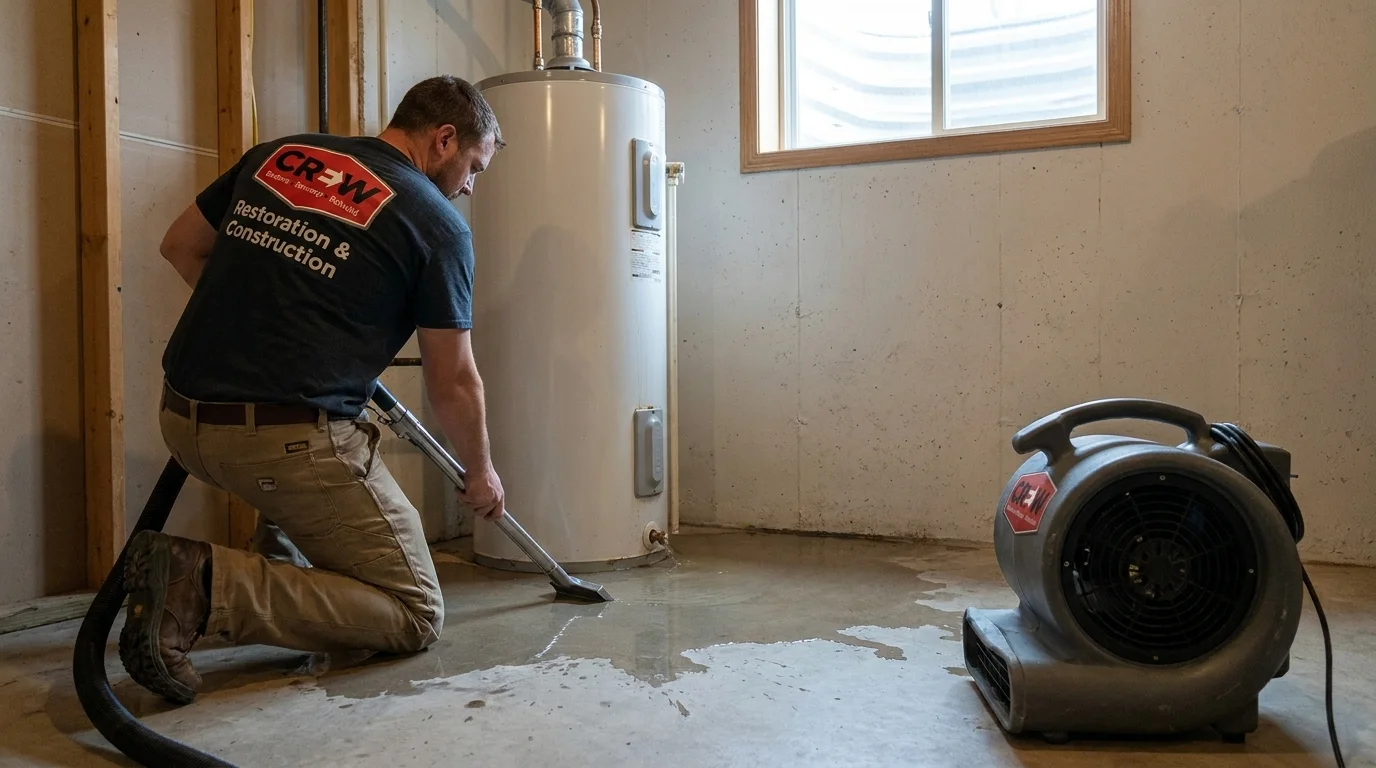
The work itself starts with confirming the water heater is fully shut off at both the supply valve and the power or gas source, since a leaking unit left partially active will keep adding water to a space that’s already been mitigated. From there it’s extraction, moisture mapping with a probe or thermo-hygrometer, and equipment placement calibrated to the actual volume of water involved, not a one-size-fits-all setup. A single tank failure in a small utility closet might dry out in two to three days with a couple of air movers and a dehumidifier. A basement flood that spread under finished flooring or into a framed wall cavity takes longer and usually means pulling baseboard or a section of drywall to dry the wall cavity directly.
Our process
- Source confirmation and shutoff verification. Before any drying equipment goes in, we confirm the water heater is isolated so the space isn’t still taking on water while we work.
- Extraction. Standing water gets pulled from flooring, carpet pad, and any pooling in low spots before drying even starts, since wet materials sitting under standing water will never read dry on a moisture meter.
- Moisture mapping. We check subfloor, baseboard, drywall, and insulation with meters to find where water traveled beyond what’s visible, including behind walls near the water heater closet.
- Structural drying and monitoring. Air movers, dehumidifiers, and sometimes injectidry systems for wall cavities go in, and we track moisture content daily until materials return to a dry standard, not just until the surface looks dry.
- Documentation and scope for repairs. Photos, moisture logs, and a written scope of any drywall, flooring, or insulation that needs to be replaced go to the homeowner and, when applicable, the insurance carrier.
What separates a good water heater flood response from a bad one
The most common mistake is treating the visible puddle as the whole job. Water from a burst or leaking tank travels along the subfloor and can wick several feet past the unit itself, especially under vinyl plank or laminate flooring that has no drainage path. Drywall wicks moisture upward from the bottom plate, sometimes a foot or more, and painting over a water stain without checking behind it just hides a problem that keeps drying wood and framing damp underneath.
Adjusters reviewing a water heater claim typically want to see moisture readings taken at the start and tracked through the drying process, not just a single before-and-after photo. They also look for whether the source was actually verified and documented, since a claim can get complicated if it’s unclear whether the failure was sudden (usually covered) versus a slow leak from long-term neglect (often excluded or limited). Getting that documentation right at the start makes the claims process considerably smoother.
What does Water Heater Flood Cleanup cost?
Costs vary with how long the water sat, how far it traveled, and whether flooring or drywall needs replacing on top of drying. These are typical industry ranges, not a quote, since every water heater flood is scoped individually before work begins.
| Scenario | Typical range |
|---|---|
| Small utility closet leak, contained and caught early | $500 - $1,500 |
| Basement leak with minor drywall or flooring affected | $1,500 - $4,000 |
| Finished basement space, water traveled under flooring | $4,000 - $10,000 |
| Extensive burst with wall cavity and framing exposure | $10,000 - $20,000+ |
Most homeowners insurance policies cover sudden and accidental water heater failures, though coverage can be limited or denied if the failure is tied to long-term corrosion or lack of maintenance. Crew Restoration & Construction provides a written scope of work before any repair or reconstruction begins so there are no surprises once drying is complete.
Seasonal & regional considerations
A lot of Sioux Falls housing stock, particularly homes built before the 1990s, has water heaters tucked into basement utility rooms near the furnace, which means a failure often sits close to ductwork, framed walls, and finished basement space rather than an isolated garage or closet. Winters here also mean water heaters work harder and longer, and units in the 8 to 12 year range are the ones most likely to fail from sediment buildup or a corroded tank bottom. Basements with sump pumps can also mask a slow leak for a while if the water finds its way toward the pump pit before anyone notices standing water elsewhere.
Service area
Crew Restoration & Construction handles water heater flood cleanup for homes and properties throughout Sioux Falls and surrounding communities including Brandon, Tea, Harrisburg, and Dell Rapids.
If a water heater has failed or is actively leaking, shutting off the supply valve is the first move, and calling before more water spreads under flooring or into framing is the second. Reach Crew Restoration & Construction at (605) 965-2727 to schedule your water heater flood cleanup and get a moisture assessment started.
Services We Handle
- Appliance Leak Cleanup
- Appliance Leak Restoration
- Busted Hot Water Heater
- Flood Cleanup
- Water Heater Leak Cleanup
- Water Heater Spill Cleanup
Frequently Asked Questions
Does homeowners insurance cover water heater flood cleanup?
How do I know if my water heater leak is Category 1 or Category 2 water?
Can water heater leak damage be fixed without tearing out drywall?
What should I do while waiting for a technician after my water heater burst?
How long does drying take after a flooded water heater?
Looking for the best water heater flood cleanup company in Sioux Falls?
Crew Restoration & Construction provides licensed and insured water heater flood cleanup in Sioux Falls, SD and the surrounding area, and has served local property owners since 2015. Customers rate us 4.9 out of 5 stars across 643 Google reviews. We answer calls 24/7 — call (605) 965-2727 for immediate help.
Request a Free Water Heater Flood Cleanup Estimate
Tell us what happened and we'll get back to you fast — usually within one business hour.
Need Water Heater Flood Cleanup now?
We respond 24/7 across Sioux Falls and surrounding SD cities.
Related Coverage
- Our Restoration Services
- Contact Crew Restoration & Construction
- Restoration Services in Adrian
- Restoration Services in Akron
- Restoration Services in Alton
- Restoration Services in Baltic
- Restoration Services in Beresford
- Restoration Services in Brandon
- Restoration Services in Brookings
- Restoration Services in Canton
- Restoration Services in Crooks
- Restoration Services in Dakota Dunes
- Restoration Services in Dell Rapids
- Restoration Services in Edgerton