Large Loss and Catastrophic Response in Sioux Falls
Large loss and catastrophic response in Sioux Falls and surrounding areas. IICRC-certified, insurance billing accepted. Call (605) 965-2727.
What Large Loss and Catastrophic Response actually involves
When a sprinkler head fails on the fourth floor of an apartment building, or a hailstorm tears through a distribution center’s roof membrane, the damage doesn’t stay in one room. It moves through stairwells, shared walls, HVAC returns, and multiple tenant units at once. Large loss and catastrophic response in Sioux Falls covers exactly this kind of event: multi-unit residential buildings, commercial properties, industrial facilities, and any loss where the affected square footage, dollar value, or number of stakeholders puts it well outside a standard single-family claim.
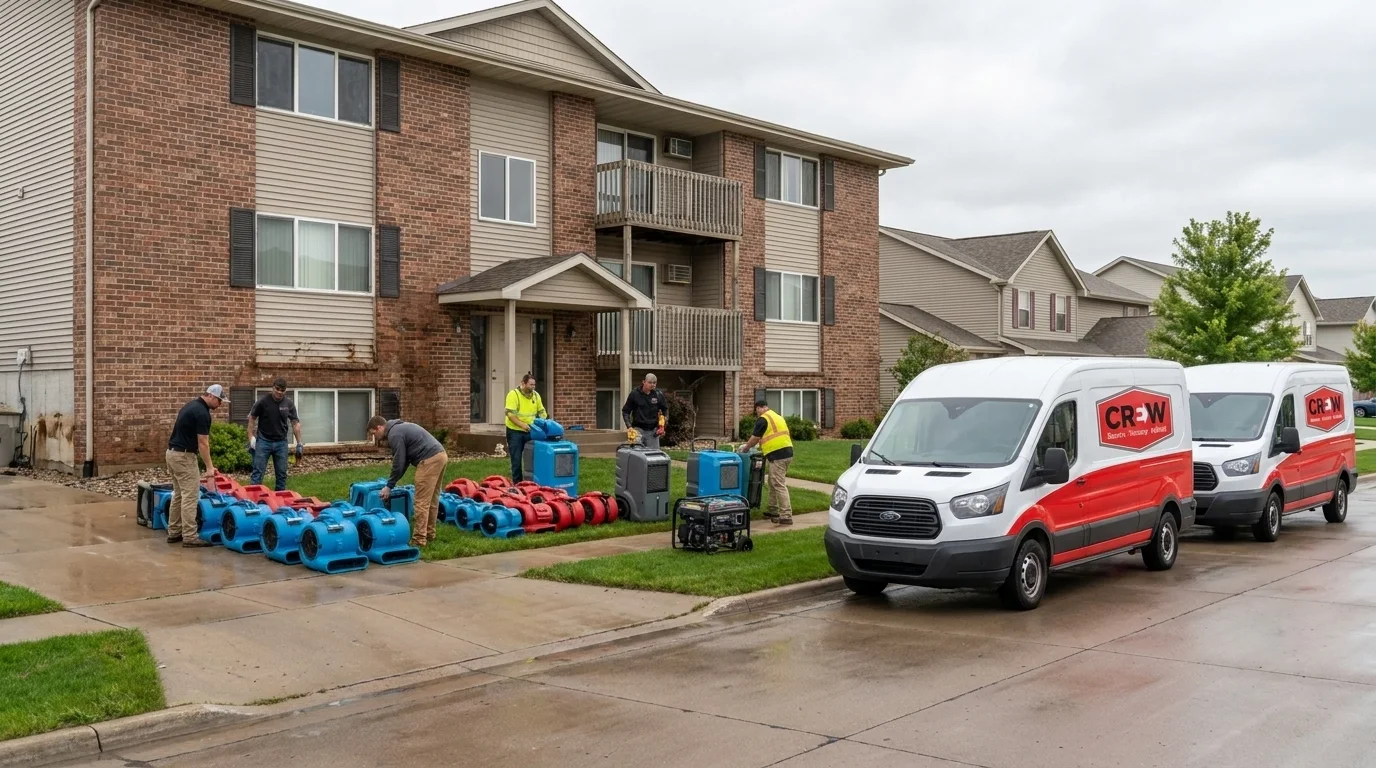
This isn’t a scaled-up version of a residential water job. It requires a different equipment footprint (industrial desiccant dehumidifiers, negative air machines, and generator-backed temporary power for buildings that may be without utilities), different logistics (staging areas, multiple access points, phased work zones so parts of a building can reopen before others), and a different documentation standard, since large losses typically involve multiple insurance adjusters, a general contractor, property management, and sometimes a public adjuster or attorney, all reading from the same file. Timelines run in weeks, not days, and drying, demolition, and reconstruction often overlap across different zones of the same property.
Our process
- Site assessment and loss documentation. We map the affected structure zone by zone, photographing and moisture-testing every area, not just the visibly damaged rooms, since water and smoke migrate through wall cavities, chases, and shared mechanical systems in ways that aren’t visible at a walkthrough.
- Mobilization and resource staging. Large loss work means moving equipment and crews at a scale a single-family job never requires: multiple drying chambers, negative air setups for containment between occupied and unoccupied sections, and temporary power where the building’s own systems are compromised.
- Structural drying and stabilization at scale. Drying is monitored daily per zone using the IICRC S500 standard as the technical baseline, with moisture logs kept for every affected area so drying can be verified room by room rather than assumed for the whole building.
- Coordination with adjusters and project stakeholders. On a catastrophic claim, you’re rarely dealing with one adjuster. We keep a single point of contact on our side so property managers, insurance carriers, and any additional consultants are working from the same daily logs and scope documents instead of conflicting updates.
- Phased handoff to reconstruction. As zones clear moisture testing, they move into rebuild while other sections are still drying, which is how occupied buildings and active businesses get back online in stages instead of waiting for the entire structure to finish at once.
What separates a good large loss response from a bad one
The most common failure on catastrophic jobs isn’t drying technique, it’s scale management. Crews sized for residential work show up with equipment that can’t keep pace across 20,000 square feet, so drying stalls in the zones that get checked last. Hidden cavities behind elevator shafts, above drop ceilings, and inside shared wall assemblies get missed because nobody mapped the full footprint before starting extraction.
The other place these claims go sideways is documentation. Adjusters reviewing a six or seven-figure claim want a clear paper trail: dated moisture readings, photos tied to specific zones, and a scope of work that matches what was actually done. A response that doesn’t track this in real time creates disputes later, often after the building is already reoccupied and the evidence is gone. A well-run large loss job keeps that log from day one and gives every stakeholder, insurer included, the same numbers.
What does large loss and catastrophic response cost?
Costs on catastrophic claims scale with square footage, number of affected units, and whether structural repair or full reconstruction is involved. These are typical industry ranges, not a quote, since every large loss is different and Crew Restoration & Construction provides a written scope of work before any work begins.
| Scenario | Typical range |
|---|---|
| Multi-unit apartment building, partial flooding | $50,000 - $150,000 |
| Commercial building, fire and smoke across multiple floors | $150,000 - $500,000 |
| Hotel or motel, multi-room water intrusion | $75,000 - $300,000 |
| Mixed-use building, storm and structural damage | $100,000 - $400,000 |
| Industrial facility, water and structural damage | $250,000 - $1,000,000+ |
Commercial property policies typically cover sudden and accidental water, fire, and storm damage, along with business interruption in many cases, but coverage varies significantly by policy and carrier, which is why documentation matters as much as the drying itself.
Seasonal & regional considerations
Sioux Falls sees a real split in what drives large loss claims by season. Spring and summer bring severe thunderstorms and hail that can compromise roof membranes across an entire building or business park in a single storm, turning a roof failure into a multi-tenant water event overnight. Winter brings the opposite risk: frozen and burst pipes in large buildings with sections that go unheated or unmonitored over a holiday closure, where a single failure can flood multiple floors before anyone notices. Properties near the Big Sioux River corridor carry additional exposure during spring runoff and heavy rain events.
Service area
Crew Restoration & Construction responds to large loss and catastrophic events throughout Sioux Falls and the surrounding communities, including Brandon, Tea, Harrisburg, and the greater Sioux Falls metro, working directly with property managers, general contractors, and commercial insurance carriers on multi-unit and commercial-scale losses.
If your property is facing damage that spans multiple units, floors, or buildings, call (605) 965-2727 to request a large loss assessment and get a documented scope of work started before the damage compounds.
Frequently Asked Questions
Does homeowners or commercial insurance cover large loss and catastrophic restoration?
What actually qualifies as a "large loss" versus a standard restoration claim?
Who manages communication when a catastrophic claim involves multiple adjusters and a property manager?
What equipment is different on a large loss job compared to a standard residential water job?
Can part of a commercial building or apartment complex stay occupied while large loss restoration is underway?
Looking for the best large loss and catastrophic response company in Sioux Falls?
Crew Restoration & Construction provides licensed and insured large loss and catastrophic response in Sioux Falls, SD and the surrounding area, and has served local property owners since 2015. Customers rate us 4.9 out of 5 stars across 643 Google reviews. We answer calls 24/7 — call (605) 965-2727 for immediate help.
Request a Free Large Loss and Catastrophic Response Estimate
Tell us what happened and we'll get back to you fast — usually within one business hour.
Need Large Loss and Catastrophic Response now?
We respond 24/7 across Sioux Falls and surrounding SD cities.
Related Coverage
- Our Restoration Services
- Contact Crew Restoration & Construction
- Restoration Services in Adrian
- Restoration Services in Akron
- Restoration Services in Alton
- Restoration Services in Baltic
- Restoration Services in Beresford
- Restoration Services in Brandon
- Restoration Services in Brookings
- Restoration Services in Canton
- Restoration Services in Crooks
- Restoration Services in Dakota Dunes
- Restoration Services in Dell Rapids
- Restoration Services in Edgerton