
Storm Damage Restoration in Rock Valley
Storm damage restoration in Rock Valley, IA. Insurance billing accepted. Call (605) 965-2727.
Our IICRC-certified technicians are dispatched from our Sioux Falls, SD headquarters and are typically on-site in Rock Valley within 60 minutes of your call.
When a severe storm rolls across northwest Iowa, Rock Valley feels it differently than most towns its size. The Rock River corridor funnels wind and water in ways that catch property owners off guard, low-lying parcels near the river bank up fast, and the flat, open terrain west of town gives thunderstorm cells almost nothing to slow them down before they hit rooftops, siding, and outbuildings. If a storm just tore through your property in the 51247 area, the window to limit secondary damage is measured in hours, not days.
Why Rock Valley Properties See Severe Storm Damage
The same geography that makes Sioux County productive farmland makes Rock Valley vulnerable to the full menu of Great Plains storm hazards: straight-line winds that routinely exceed 70 mph during summer derechos, hail that strips shingles and dents aluminum fascia, and rapid-onset flooding when the Rock River rises after a heavy rain event. Historically, low-lying properties near the Rock River have taken on water before county road crews can even assess culvert capacity, basements flood, crawl spaces saturate, and framing lumber begins absorbing moisture within the first few hours.
Older homes near Downtown Rock Valley, many built in the mid-20th century with wood-framed construction and original windows, are especially exposed. Single-pane glass fails under hail impact that modern double-pane units would survive, and older roof decks with thinner sheathing can delaminate after a single hard storm. That combination of aging materials and river-adjacent topography means storm losses here tend to involve multiple damage categories at once: structural, water intrusion, and debris, all needing attention in the right sequence.
Our Storm Damage Restoration Process in Rock Valley
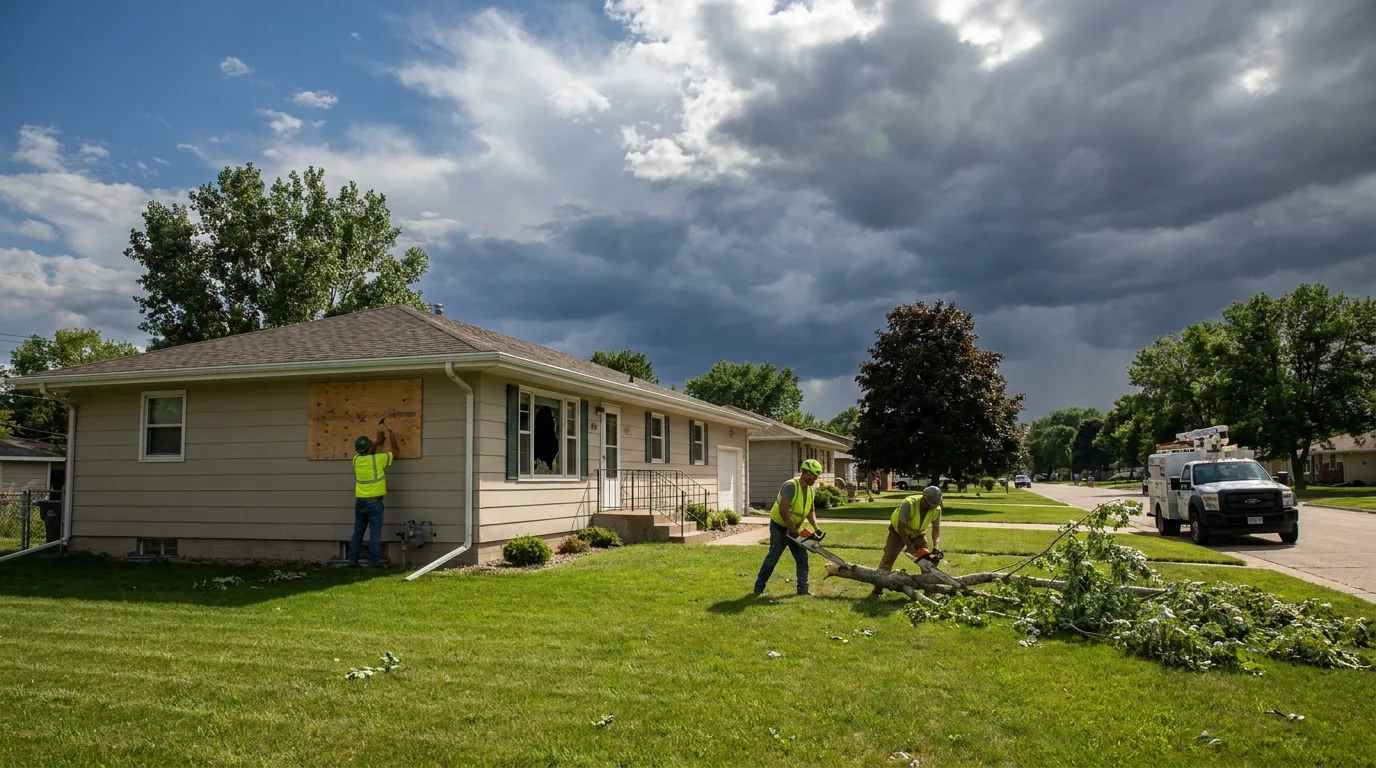
The first step on any storm job is a systematic exterior and interior assessment before any materials are moved or discarded. Tarping and board-up happens immediately to stop rain from entering through a compromised roof or broken window, every hour of additional water intrusion widens the scope of the job. We document everything photographically as we go, which matters for your insurance adjuster later.
Once the structure is stabilized, the work shifts to water extraction and drying if the storm brought interior moisture with it. Industrial air movers and desiccant dehumidifiers run until moisture readings in walls, subfloor, and framing return to acceptable levels, skipping this step is how mold problems develop within the first week after a storm. Debris removal, structural repairs, and reconstruction follow in a sequence designed to avoid rework: you do not want new drywall going up over framing that hasn’t fully dried.
For tree damage, a common outcome when storms push through the mature tree canopy around Rock Valley City Park and residential streets nearby, we coordinate safe removal of lodged limbs and assess the structural integrity of any roof or wall section the tree contacted before reconstruction begins.
Reaching Rock Valley from Sioux Falls
Crew Restoration & Construction operates out of Sioux Falls, SD, and dispatches crews to northwest Iowa storm jobs regularly. Rock Valley sits roughly 90 miles southeast of Sioux Falls via I-90 and US-75, a route our crews travel to reach Sioux County properties. When you call (605) 965-2727, our team will confirm scheduling and give you a realistic arrival window based on current crew availability and any active storm volume in the region. We will not promise a number we cannot keep.
Rock Valley Insurance Coordination
Storm damage claims in Iowa typically involve your homeowner’s carrier, and the documentation phase we complete during assessment is built specifically to support that process. We photograph damaged materials before removal, note pre-existing conditions separately, and provide a detailed scope of work that adjusters can cross-reference against their own inspection. If your carrier sends an independent adjuster to the property, we can walk the site with them to answer technical questions about the damage sequence, how the roof failure led to interior water intrusion, for example, or why a section of framing needs replacement rather than drying in place.
If your property is in a flood-prone area near the Rock River and you carry separate flood coverage through the National Flood Insurance Program, the documentation requirements differ from a standard homeowner’s claim. We are familiar with both claim types and will flag early which category applies to your specific loss.
Local Note
One pattern we have seen repeatedly on Rock Valley jobs: properties in the Rock River area that appear to have only roof damage often have a secondary moisture problem in the basement or crawl space that started from the ground up, not from the roof down. When the river rises quickly after a storm, hydrostatic pressure pushes water through foundation walls and floor cracks even when the roof is intact. If your property sits in a low-lying area near the river, ask us to check below-grade moisture levels during our initial assessment, even if the obvious damage is overhead. Catching that early saves a separate remediation job later.
If your property in Rock Valley was hit by a recent storm, call (605) 965-2727 to schedule an assessment. The sooner the structure is stabilized and drying begins, the narrower the final scope of repairs, and the faster you can get back to normal.
Serving Rock Valley from our Sioux Falls headquarters — ★ 4.9 · 554 Google reviews
“Zach is wonderful. Easy on the eyes ;)” — J, September 2026Read our reviews on Google →
Storm Damage Restoration in Rock Valley: Service Coverage
Frequently Asked Questions
How fast can you arrive for storm damage restoration in Rock Valley?
Are properties near the Rock River at higher risk for compounded storm damage?
How does Rock Valley's older housing stock near Downtown affect the storm restoration timeline?
Does Iowa's storm season affect how quickly you can schedule a Rock Valley job?
What does the drying process look like after a storm causes water intrusion in a Rock Valley home?
If my Rock Valley property has both a homeowner's policy and NFIP flood coverage, how do you handle documentation for two separate claims?
Will my homeowners insurance cover storm damage restoration in Rock Valley?
Storm Damage Restoration response in Rock Valley
Most Rock Valley calls see a technician on-site within 60 minutes from our Sioux Falls headquarters.