
Water Damage Restoration in George
Water damage restoration in George, IA. Insurance billing accepted. Call (605) 965-2727.
Our IICRC-certified technicians are dispatched from our Sioux Falls, SD headquarters and are typically on-site in George within 60 minutes of your call.
When snowmelt and spring rains push across Lyon County’s flat terrain, George’s older housing stock takes the hit first. The town sits in Iowa’s northwest corner where the ground freezes deep in winter and thaws fast in March and April, a cycle that stresses foundations, shifts drain tiles, and sends water into basements that were never designed to handle that kind of hydrostatic pressure. If you’re dealing with standing water, soaked drywall, or a crawl space that smells like a river bottom, Crew Restoration & Construction handles water damage restoration in George and the surrounding 51237 area.
Why George Properties See Water Damage Issues
George is a small farm town, and much of its residential housing was built before 1970, some of it well before that. Older homes here tend to have block or stone foundations with aging mortar joints that let groundwater seep through during heavy saturation events. Drain tile systems that were installed decades ago can collapse or clog with silt, redirecting water toward the structure rather than away from it.
The Lyon County line sits just miles from town, and the agricultural fields surrounding George drain quickly during rain events, pushing surface water toward low-lying residential lots. Downtown George and North George both have streets where the grade works against homeowners, water follows the path of least resistance, and sometimes that path leads straight to a crawl space or basement floor drain that backs up under pressure. Sump pump failures during a power outage are among the most common calls we receive from this area.
Our Water Damage Restoration Process in George
The first step on any job is moisture mapping, we use thermal imaging cameras and calibrated moisture meters to find water that has already migrated behind walls, under flooring, or into subfloor sheathing. In George’s older homes, this step matters more than in newer construction because plaster walls and tongue-and-groove wood subfloors hold water differently than modern materials. Water can travel six to eight feet from the visible wet area before you’d notice it by touch.
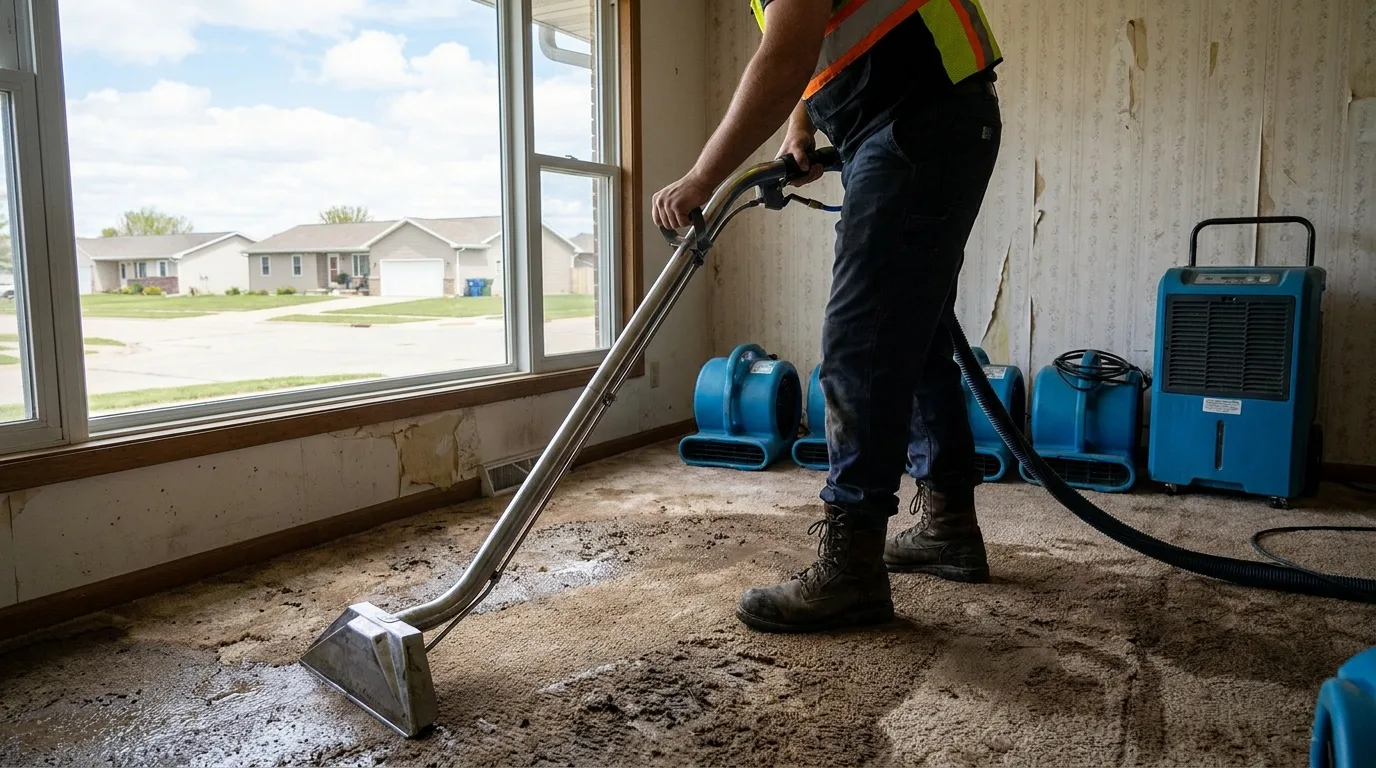
Once we understand the full extent of the loss, we extract standing water with truck-mounted and portable extraction units, then set industrial desiccant or refrigerant dehumidifiers and high-velocity air movers calibrated to the room’s cubic footage and the material types present. Drying logs are recorded daily so there’s a documented record of progress, something your insurance adjuster will ask for. We don’t pull equipment until moisture readings in walls, floors, and structural members return to pre-loss baselines, not just until the surface feels dry.
If flooring, drywall, or insulation is too saturated to dry in place, we remove and dispose of it properly and document everything before demolition begins. Structural drying in George’s older homes sometimes requires opening wall cavities to dry the framing directly, a step we don’t skip because trapped moisture in a wall cavity is where mold colonization begins, typically within 48 to 72 hours of a water event.
Reaching George from Sioux Falls
Crew Restoration & Construction is based in Sioux Falls, SD, and George is a straight shot south on US-75 through Larchwood and into Lyon County, a route our crews know well from serving northwest Iowa. When you call (605) 965-2727, we’ll give you an honest estimate of when a crew can be on-site based on current scheduling and distance. We don’t make response-time promises we can’t keep, but we do prioritize active water intrusion calls because every hour of delay expands the affected area and the cost of the job.
If you’re near George City Park or on the north side of town, let the dispatcher know your cross streets, it helps the crew navigate directly to you without circling.
Local Note
Something worth knowing if you own an older home in George: the original drain tile systems installed around foundations in this part of Lyon County were often clay pipe, and clay tile collapses over time as soil shifts. When a clay tile system fails, it doesn’t just stop draining, it can actually redirect groundwater toward the foundation rather than away from it, creating recurring basement flooding that looks like a sump pump problem but is actually a perimeter drainage failure. If your basement floods repeatedly in the same corner every spring, that pattern is worth investigating before the next melt season. We note what we observe during a water damage job and can flag signs of tile failure for a plumber or drainage contractor to evaluate.
If your George home has experienced water damage, whether from a burst pipe, appliance failure, sewer backup, or storm-driven groundwater, call Crew Restoration & Construction at (605) 965-2727. We’ll assess the damage, walk you through the drying process, and work with your insurance carrier so the documentation is in order from day one.
Serving George from our Sioux Falls headquarters — ★ 4.9 · 554 Google reviews
“Zach was professional, on time, helpful, or great to work with would be perfect.” — Caleb, September 2026Read our reviews on Google →
Water Damage Restoration in George: Service Coverage
Frequently Asked Questions
How fast can you arrive for water damage restoration in George?
Are homes in North George more prone to basement flooding than other parts of town?
How does Lyon County's spring thaw affect the timeline for water damage drying in George?
What should I do immediately if I find standing water in my George home before your crew arrives?
Does the age of housing stock near Downtown George affect how long structural drying takes?
Will my homeowner's insurance cover water damage restoration in George, and how does Crew Restoration handle the claim?
Water Damage Restoration response in George
Most George calls see a technician on-site within 60 minutes from our Sioux Falls headquarters.